Polypropylene plates
The evaporator core is built from PP plates. Plastic does not corrode, so no expensive alloys or anti-corrosion chemicals are needed.
 Pilot phase
EvaPlate is developing a compact evaporator for wastewater and process streams. It is built from a stack of polypropylene plates instead of special metal alloys, runs fully electric on a water-to-water heat pump and fits inside a shipping container. Affordable evaporation, for the low/mid volume range.
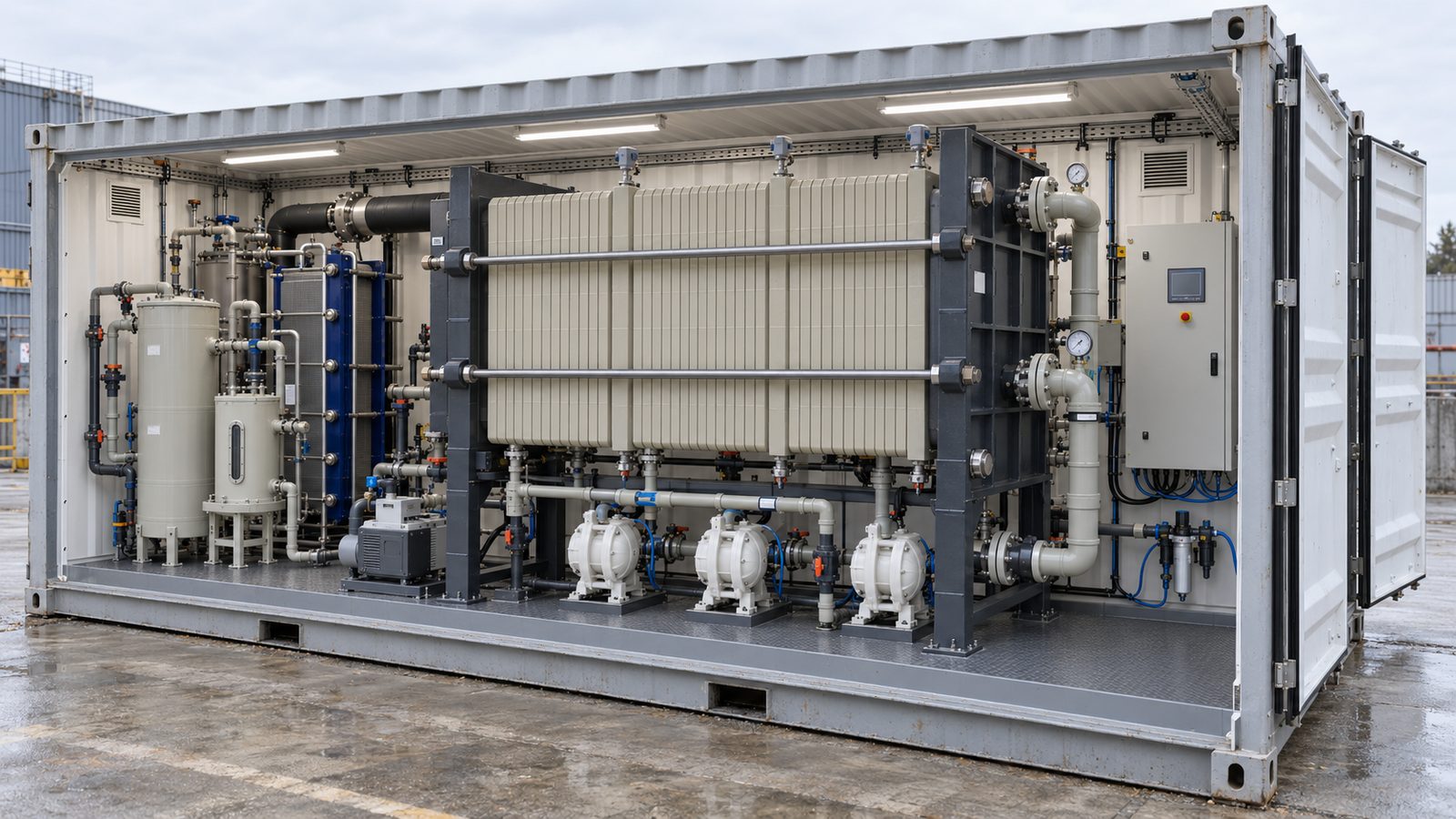
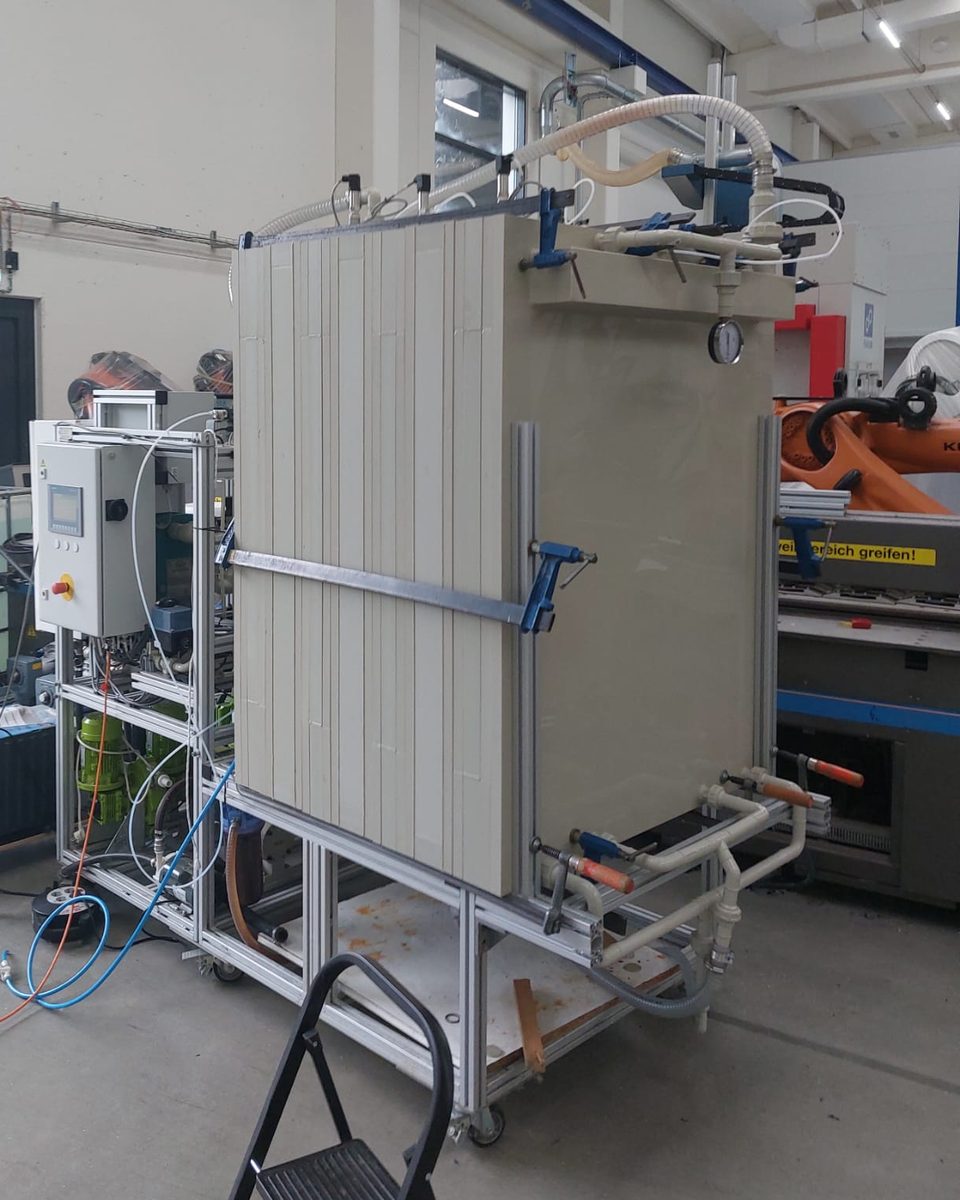
EvaPlate is in development and not yet commercially available. Over the past year we tested a first generation of plates in a pilot. We are now finishing the second plate design (V2), which goes into a 100 L/h pilot at the end of 2026. We aim for commercial availability of the first evaporators at the end of 2027.
This page explains what we are building and where the project stands. It will be updated as test results come in.
EvaPlate is a multi-effect evaporator (MED) of the falling-film type. It runs under vacuum, so water boils at low temperatures. That is what lets us build the evaporator from plastic. The number of effects can be chosen from 1 to 6, or more if required.
Feed liquid runs down the evaporation plates as a thin film. On the other side of a thin heat-transfer layer, vapour from the previous stage condenses and gives up its heat, which boils part of the film.
Each effect runs at a lower pressure and temperature than the one before, and its vapour heats the next. More effects reuse the energy more often. Fewer effects keep the unit smaller. The choice depends on the application.
The heat pump's hot side drives the preheater. Its cold side cools the final condenser. The heat removed at the cold end is lifted and returned to the hot end, so no steam boiler or cooling tower is needed.
Most evaporators are welded vessels of special alloys, hard to reach inside and prone to corrosion and fouling. EvaPlate takes a different route, borrowing from the plate-and-frame filter press. Every principle below aims at a lower cost over the lifetime of the unit.
The evaporator core is built from PP plates. Plastic does not corrode, so no expensive alloys or anti-corrosion chemicals are needed.
Release the clamping and slide the plates apart. The heat-transfer surfaces can be inspected, cleaned or replaced on site, by your own staff.
Each evaporation plate is designed for about 20 L/h of condensate. Capacity is set by how many plates sit in the stack.
Heating and cooling come from one water-to-water heat pump. No steam boiler, no gas, no separate cooling supply: just a power connection.
Stack, heat exchangers, pumps and controls are laid out to fit a shipping container, so a unit can be delivered complete and moved between sites.
The plates are made from a single polymer type, so the evaporation core can be recycled at the end of its service life.
All tests use a water-to-water heat pump as the source of heat and cooling, the same setup the full-size units will use. The plates are developed and produced together with our partner Kuypers Kunststoftechniek.
First generation of plates tested in a pilot setup over the past year. The results feed directly into the second plate design.
A redesigned plate with improved sealing, frame stiffness and easier replacement of the heat-transfer surfaces.
V2 plates built into a new four-effect pilot producing 100 litres of condensate per hour.
Both full-size evaporators are built and tested: the EVA-500 (500 L/h condensate, 20 ft container) and the EVA-1000 (1,000 L/h condensate, 40 ft high-cube container).
First evaporators available to customers.
Industrial streams in the lower volume range, where conventional evaporators are too expensive to run.
Smaller volume to transport and treat off-site.
Recovered nutrients or chemicals as a product.
Concentrate goes back into production, towards zero liquid discharge.
Distilled water for reuse, or as drinking water.

Kuypers Kunststoftechniek BV is an engineering and manufacturing partner of EvaPlate.
Whether you want to follow the pilot results, discuss a possible application or explore working together, we are happy to talk. If you have a stream in mind, it helps to share its volume and composition.